
In case you didn’t know, I’m a big spreadsheet nerd. Shocking, right? Before you judge too much, don’t forget that it led to the creation of the Shatterpoint dice simulator. Stats and data can be deceiving, but with the right context and a big grain of salt, we can still extract some useful findings. The latest Shatterpoint world championship wrapped up recently at Adepticon (you can check the top 8 lists here if you haven’t already) so of course I had to dive into the nitty gritty.
The worlds-related Shatterpoint events at Adepticon consisted of a qualifier on Friday, a top 64 on Saturday, then a cut to top 8 on Sunday. For the purposes of this deep dive, I chose to look only at the top 64 and top 8. GT winners qualified automatically and thus didn’t play Friday. Since these are some of the top players and many of the people who went on to make the cut, it made sense to start the deep dive only when they entered the event. Of the 132 games played on Saturday and Sunday, 131 were examined. The lone exception was a draw on Saturday because changing up my spreadsheet to handle draws just isn’t worth the effort.
Bring Rate
Since we’re looking at the last 64 players, each character in the game could have conceivably been brought 64 times. I am defining bring rate simply as times brought divided by possible times brought.
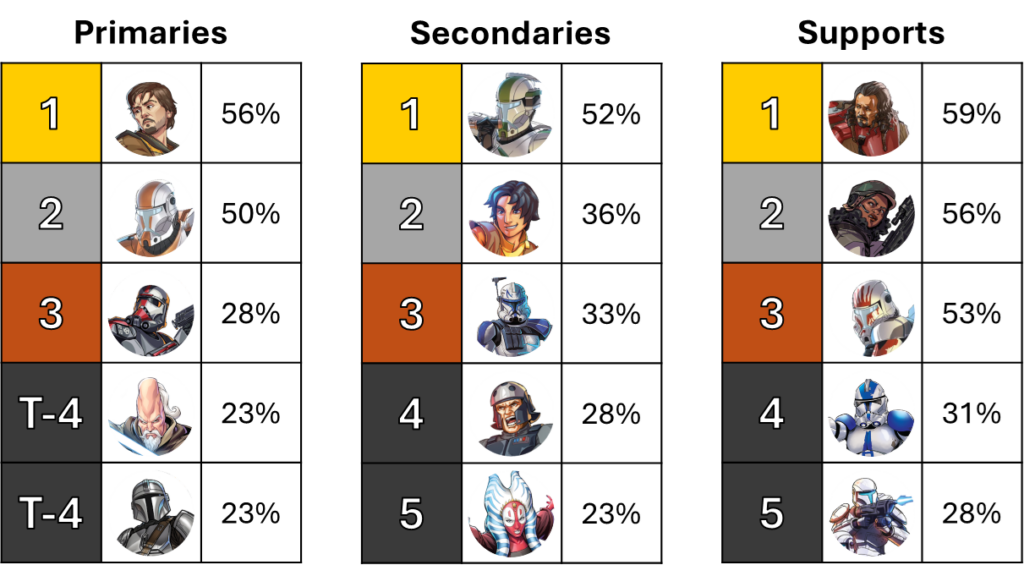
For primaries, there’s a clear top two and it’s not even close. Half the players brought Boss, more than half brought Cassian. Seventeen players brought both. In third place we get Clone Sergeant Hunter, a common Boss pairing. Ki-Adi-Mundi is the unit that really catches my eye here; he’s very strong, but doesn’t play nicely with Boss. Delta Squad prefers a clone focused strike team, whereas Ki-Adi needs some Jedi friends. A high bring rate for Ki-Adi points to a decently showing for non-Boss republic.
For the secondaries, Fixer was far and away the top pick. Considering the high pick rate for Boss this isn’t especially surprising, and a republic has so many ways to move his tiebreaker around that Fixer can fit easily even into non-Boss lists. Ezra is often the most popular rebel secondary, and considering they had a big showing, it’s no wonder he shows up high on this list. He combos especially well with Cassian because moving a tiebreaker around with the revenge movement can be extremely strong. Speaking of rebel secondaries, Kallus deserves a callout. I like Sabine, but also recognize list building with her is tricky because she usually wants other Spectres. Kallus fits into a lot of lists and perfect information rerolls are always great. Rex is a republic staple and Shaak Ti comes in at 23%, the exact same as Ki-Adi. Coincidence? I think not! Well, it is, and it isn’t, I guess; not every Ki-Adi team had Shaak Ti, but most did.
The top three supports don’t need much introduction. In my community tier list back in December they were easily the top three ranked supports. Rebels also don’t have much competition, sadly, as I think the quality drops off significantly after the top two. I am surprised to see clones in both fourth and fifth place, though. It seems 501st have emerged as the 3pc clone support of choice (people like killing things) while the vertical mobility and extra durability for Clone Commandos make them a solid choice.
Not Brought
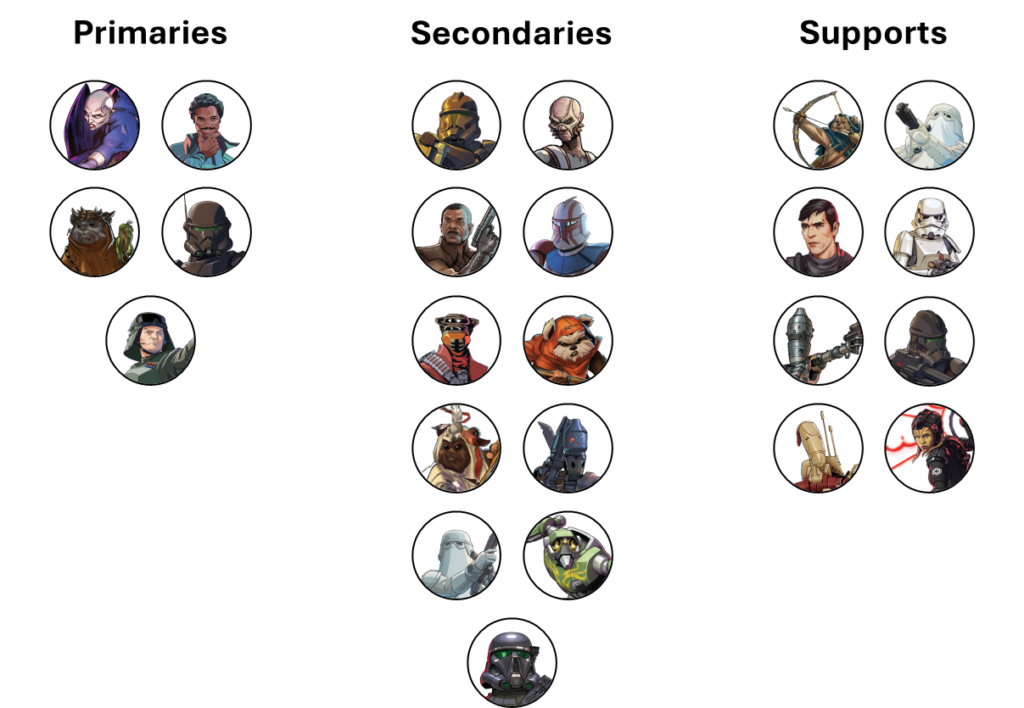
Well, that’s a lot of units. I’d say most of the units are not great, so I understand why they weren’t brought. Based on interviews with developers at Adepticon, it sounds like this May will be a smaller update than last year with the number of units maybe reaching the teens. With 24 units above, not all will see buffs. However, I do think some, like Kraken and Elite Squad Troopers, could still see a lot more play if the things around them are improved.
I do have on very specific callout: stormtroopers being on this list is a tragedy. If generic stormtroopers aren’t showing up to a big event for a Star Wars game then something has gone wrong.
Pick Rate
Due to the nature of premier events, each player will only play half of their squads each round. I’m defining pick rate as the number of times a squad was played divided by the total possible times it could have been played by those who brought it. For example, if Unit X was in three players’ lists, and those players played a total of 16 games, and Unit X was played 4 times, the pick rate would be 25%. For the figures below, I’m only showing units brought a minimum of five times.
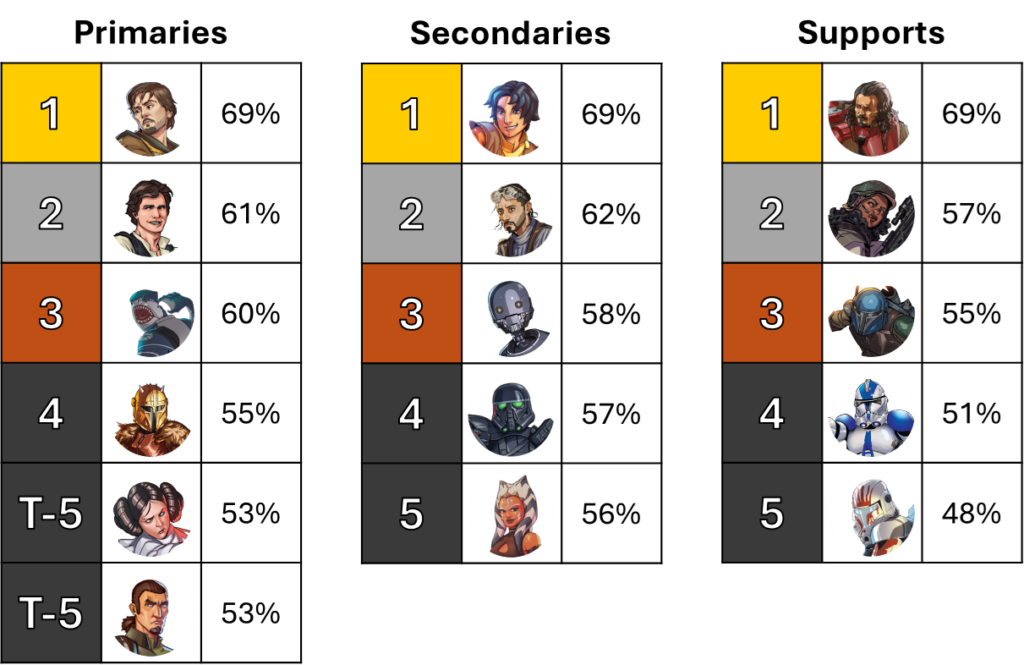
Remember that the average pick rate should be 50%, since half of the units brought are played each game. As such, the numbers much greater than 50% are the most eye-popping. Cassian, Ezra, and Baze & Chirrut are all looking nice, being picked in more than 2/3 of their games. While these three units are often brought as a single squad, they aren’t always so the pick rates lining up is kind of a coincidence.
Across all unit ranks, rebels were clearly the go-to for many players. Four of the top six primaries are rebel plus the top three secondaries and the top two supports. As someone who was consistently reaching for my rebel squad, I get it. Rebels boast great revenge plus a variety of other tools. Of course Cassian is great (too great) but their bench ain’t bad either.
Riff is a bit of an outlier amongst the primaries in that his win rate was terrible, but he kept getting picked. He appeared in 12 of a possible 20 games but only won two of them. I like Riff and think he’s a good piece, but right now it is kind of awkward to pick stuff around him. Separatists aren’t great and the best scoundrel units aren’t in Riff’s era. We know B1s are getting some help and they combo well with Riff (they can expose the target before his follow-up) so perhaps he’ll see better results soon.
One small note regarding supports, since it might seem weird the fifth highest pick rate is below 50%: there were a lot of supports that weren’t brought much but picked often by the players that did. The threshold of being brought five times thus makes the support data look a little funky on first glance.
Win Rate
Mirror matches were removed for all win rates shown in this article since they drag win rates closer to 50% and disproportionately affect more popular units. I chose to filter for a minimum of five games played.
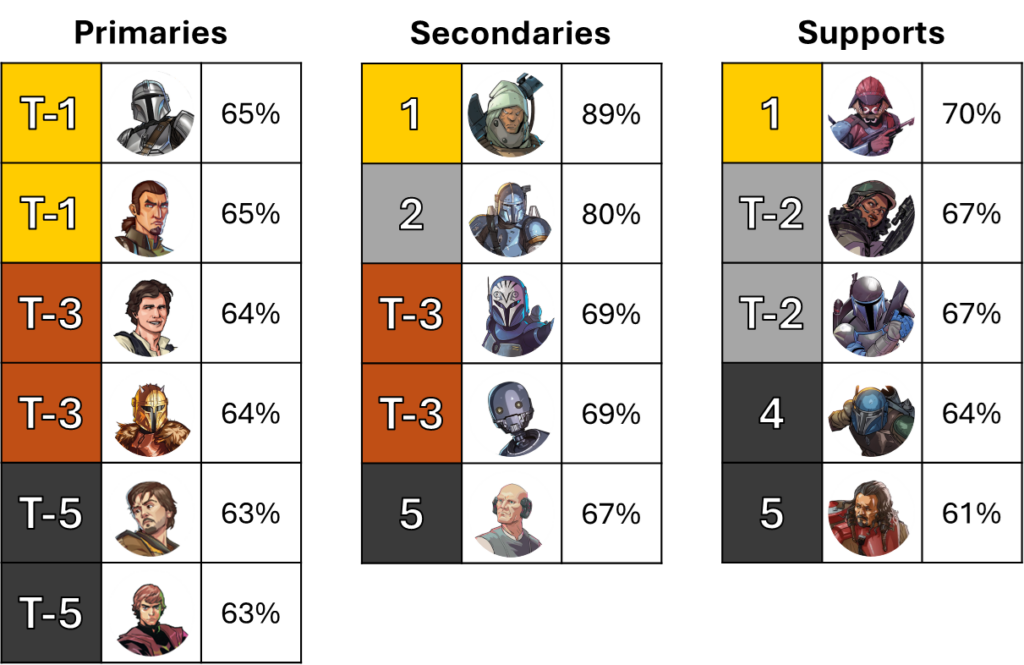
Hey, look! Cassian isn’t #1 for primaries, so clearly there isn’t a problem. Also please don’t ask who Kanan, Han, and Luke were most often paired with. While there isn’t much to say about the primaries, I do think the mandos are worth mentioning. Full mandos are generally seen as fine, but not great. The Armorer didn’t appear in the top 8, so maybe this tournament data agrees with that. However, I would be surprised if any Mandos receive nerfs in May, and Strategic Positions helps a lot with the Paz problem (he is slow), so I do want to keep an eye on them.
Now, as a general disclaimer for this whole article, it can be difficult to disentangle cause and effect. Are the units above the best units, or just what the good players think is best, and thus play? We can never know for sure, probably a bit of both. Take everything here with a grain of salt.
Anyway, for secondaries and supports, Dengar and Lando & R2 are surprising at the top of the charts. Neither were super popular, but clearly the players who brought them did well. I wouldn’t expect Dengar to be the driving force in his wins, but he seems far from a liability here.
Looking away from specific primaries, I wanted to investigate how different varieties of revenge performed. To do so, I put together a short list of all revenge units in the game, shown below. Self-revenge (like Maul) didn’t count, nor characters who don’t generate movement or attacks (like Luminara). Lists with none of these characters were classified as “None” while having any one character designated a lists as “Single.” Two or more characters meant the list was “Multiple.” I didn’t want to slice the data too thin by doing “Double” vs. “Triple” and, from personal experience, the 1 vs 2+ demarcation is really where things get interesting.
| Revenge Characters | ||
| Captain Cassian Andor | The Mandalorian | Mother Talzin |
| Kanan Jarrus, Spectre-1 | Ahsoka Tano, Jedi No More | Bossk, Single-Minded Slayer |
| Princess Leia, Charming to the Last | Count Dooku, Separatist Leader | Chief Chirpa |
| General Solo | Hondo, Honest Businessman | Bossk, Single-Minded Slayer |

You might be surprised to see just how many players played games without any revenge. After all, as we saw above, Cassian was brought a lot and picked a lot. Well, here’s a little secret: Cassian was featured in 104 of the 128 revenge games. Also, it is important to clarify that each game is really two games here, because two lists are played each game.
The sheer dominance of multiple revenge is really quite staggering. It’s not often win rates go as high as the 70s. The Multiple vs. Single sample size is rather small, eight games where each type won four times, so mainly Multiple was beating up on None. What surprises me is None beating up on Single. Single would include most republic lists, including Delta Squad, so I guess that kind of makes sense. I’ve found dealing with a single revenge trigger much easier than with two or more. Negating Cassian can be done, but Cassian with help from another revenge character is nasty (still possible to overcome, but harder).
Never Won
Last year I had a section where I went through the last round each unit recorded a win. However, last year that was much more useful because there were five single elimination rounds, compared to just three this year. Including swiss doesn’t make sense because a unit winning in round 4 of swiss doesn’t necessarily mean much. If you want to know what won in the top 8, take a look at my other recap article. However, I still want to take a quick glance at units that were played, but never won.
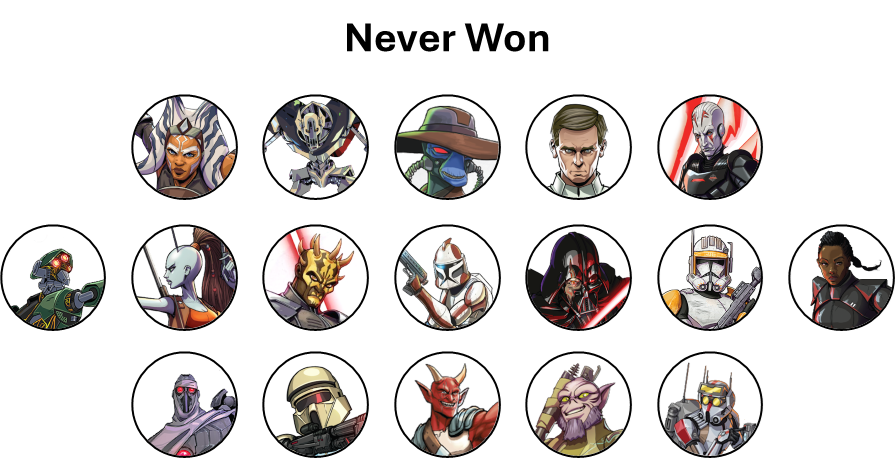
It’s an interesting list. Some of these units are, in my opinion, not good and some are quite good, but without a great home at the moment (Aurra, Darth Vader). I also think it’s interesting that the two Imperial primaries here, Krennic and Grand Inquisitor, are both good but want to be getting wounds. It makes sense that these units wouldn’t be played much in a revenge heavy meta, and if you aren’t played much then the chances of going winless shoot up.
Similar to the units not taken, I hope some of these units are included in the next update or at least get better as the things around them are raised up.
Wounds

Let’s add a little context to these numbers: last year the average wounds were 4.0 and 3.3 for the winners and losers, respectively. Therefore, we’ve seen both numbers increase by about half a wound per game. That seems pretty significant! The game is getting more deadly. That observation isn’t especially surprising since both Cassian and Delta are known for dishing out a lot of damage.
While it was generally rare for a player to lose a game when getting more wounds, the top 8-only data actually jumped from 24% to 43%. I bring that up just to say that, while wounding more than your opponent is generally good, it definitely isn’t necessary to win.
Objectives
These are the stats I was most interested in, so I’m saving the best for last. Last year Longshanks didn’t record who was first player, but now it does so we have even more data to look at! To begin, let’s start with the most basic level: what did people bring to the event.
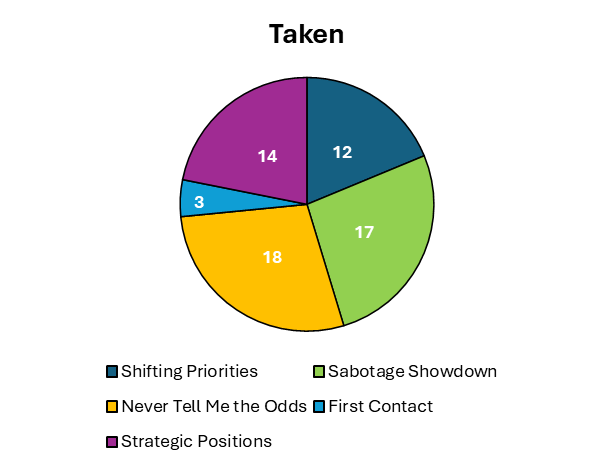
So that’s a pretty even split, except for First Contact. Let’s talk about that for a moment. I try not to be too negative here, but I really dislike First Contact. To be clear, I think it’s close to being a fine mission, but in the current state it’s just terrible for competitive play. The layout-switching mechanic in the later struggles is cool, but slows the game down because most turns less points are scored than usual. Players are often spending momentum to swap the layouts, too, which also slows down the game. Altogether, First Contact games can take forever and clocking out in a tournament is not good. Even if you’re the winner, winning with just a single struggle taken is not ideal for tiebreakers. Unfortunately, I would highly recommend not taking First Contact to a competitive event until it’s changed.
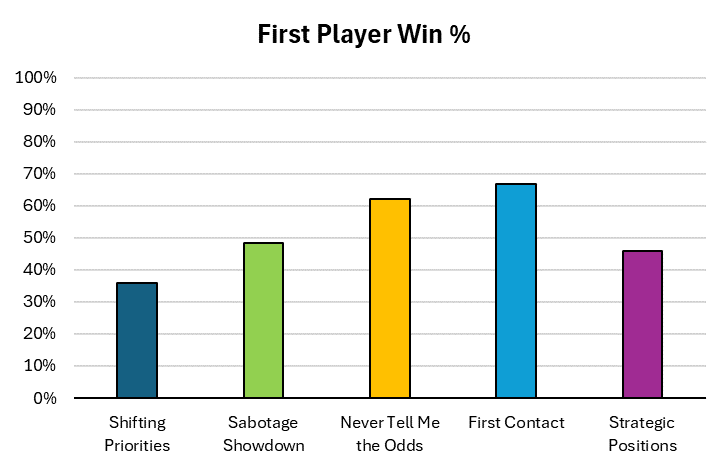
OK, back to the fun stuff. Note that only three games of First Contact were played, so that sample size is incredibly small. Overall, the first player won 49.6% of the time, so very close to the ideal 50/50.
Shifting Priorities stands out in a bad way here; the first player won only 36% of the time. That is not good at all and doesn’t make me want to bring Shifting. I think most strike teams that were bringing Shifting before should probably be switching to something like Strategic Positions these days. On the other end of the spectrum, Never Tell Me the Odds turned out great for first player. But is that inherent to the mission, or something else? Well, in games where both players brought Odds, the first player won 7 of 15, as close to 50/50 as you can get. To really see the advantage, we need another piece of data …
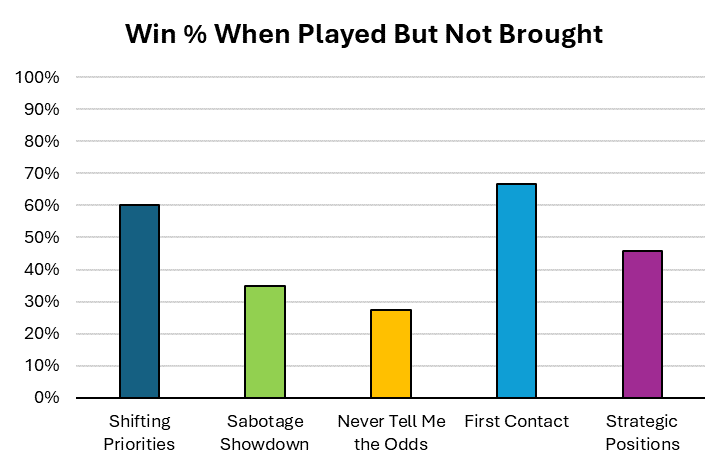
When someone who didn’t bring Odds had to play it, they won only 27% of the time. Yikes! The power of Odds doesn’t come purely from being first player, but rather that many lists don’t love playing it. The number is extreme, but I expected Odds to perform well with this metric (which is why I brought it in my list). However, I am definitely surprised to see the numbers for Sabotage Showdown. Players who didn’t bring it won only 35% of the time when playing it. I generally think of Sabotage as a fairly neutral objective that most lists play well on, so this number is much lower than I expected. Last year it was just a bit below 50%. I’m honestly not too sure what to say here, other than this is something I will keep an eye on. Perhaps I have underestimated Sabotage!
Wrap-Up
Well, I enjoyed that! I hope you did too. Much like my annual tier lists, I think data like this gets more useful when we can compare it over time. I made a few comparisons to 2025 in the text above, but if you want to dive even deeper then you can check out the previous article here. I look forward to doing this again next year!